Contents
- Executive summary
- Introduction
- Background: how settlement risk shaped market infrastructure
- Key terms
- The stablecoin settlement landscape
- The problem: how stablecoin markets settle today
- The economics of gross settlement
- The options
- The solution: covered multilateral netting
- Confidentiality: who sees what
- When things go wrong
- Evidence and case studies
- Simulation: what drives the netting ratio
- Regulatory and legal landscape
- Trade-offs and limits
- Implementation roadmap
- Measuring results
- Questions to ask of any clearing arrangement
- Frequently asked questions
- Conclusion
- About TetraFi
- Important information
- Appendix: methodology behind the illustrative cases
- Sources
Executive summary
Stablecoin markets moved an estimated $28tn in 2025, yet most obligations between firms still settle gross, one transfer at a time, with capital parked in advance (BIS Annual Economic Report 2026). The infrastructure that removed this cost and risk for banks does not reach the firms that now carry it.
This paper reaches six conclusions:
- The gap is structural, not technical. Clearing houses and payment-versus-payment systems serve well-capitalised members and eligible currencies. Where FX trades could not use PvP in 2025, 57% of counterparties simply lacked access (BIS, June 2026).
- The risk model already exists. CHIPS settled $2.014tn a day in 2025 with about $96bn of funding, and CLS netting cuts its members’ funding needs by over 96%. Neither uses a guarantee to remove principal risk.
- Covered multilateral netting applies that model to stablecoin obligations. It nets across venues, chains and counterparties, covers every net debit before a run commits, and discharges obligations only once every residual has settled, with no novation and no shared losses.
- The economics are material. In an illustrative case, a desk settling $100m a day that nets 55% of its flow avoids about $6m a year in settlement tolls and frees $100m of prefunded balances. In simulation, the ratio approaches the share of members’ flow that runs in both directions: a 25-member network with 60% two-way flow nets about 56%.
- The limits are real. Covered netting suits short-dated obligations, leaves bilateral exposure before each run, settles in assets that carry issuer risk, and relies on contract rather than statute for legal certainty. Its value grows with the density of its network.
- Firms can test it cheaply. The evaluation questions in this paper apply to any provider, and a netting simulation on a firm’s own flows shows what it would release.
Introduction
Every day, about $1.4tn of foreign exchange settles with one side paying before the other receives (BIS, June 2026). That exposure has a name, settlement risk, and five decades of market infrastructure exist to remove it.
Stablecoin markets largely sit outside that infrastructure. Desks, payment companies and remittance firms settle each obligation in full, one transfer at a time, and park capital in advance at every venue and on every chain. The clearing houses and payment-versus-payment systems that solve this elsewhere serve well-capitalised members and standardised products, and most stablecoin flows fit neither.
Three developments make the question pressing now:
- Regulation. The US signed the GENIUS Act into law in July 2025, creating its first federal regime for stablecoins and requiring full reserve backing with liquid assets such as dollars or short-term Treasuries (White House, July 2025). MiCA’s rules for stablecoin issuers have applied in the EU since June 2024 (Central Bank of Ireland), and Hong Kong granted its first stablecoin issuer licences in April 2026 (HKMA, April 2026). Regulated issuers make stablecoins usable as a settlement asset for regulated firms.
- Scale. Stablecoin market capitalisation passed $307bn in December 2025, about 50% higher than a year earlier (BCG, January 2026), and stood at about $307bn in late September 2026 (DefiLlama).
- Design. Central banks are testing the same settlement sequence this paper describes. Project Agorá brings together eight central banks and over 40 regulated institutions, and settles atomically only after the required balances are reserved and locked (BIS Annual Economic Report 2026).
This paper is for treasury, operations and risk leads who settle stablecoin obligations and want to move less money with less risk. It covers:
- How settlement risk shaped today’s market infrastructure, and the terms used to compare settlement models.
- The stablecoin settlement landscape, and how it settles today.
- The economics of gross settlement, with worked numbers.
- The options open to firms outside clearing houses, and how each works.
- Covered multilateral netting, element by element, with a worked run, and how it handles confidentiality and failure.
- Evidence from existing systems, illustrative scenarios, and a simulation of what drives the netting ratio.
- The regulatory and legal landscape, and the model’s trade-offs and limits.
- An implementation roadmap, the metrics that matter, and questions to ask of any clearing arrangement.
Background: how settlement risk shaped market infrastructure
Modern settlement infrastructure traces back to one afternoon in 1974. At 15:30 CET on 26 June, German authorities closed Bankhaus Herstatt. Some counterparties had irrevocably paid Deutsche marks but had not yet received dollars, because New York had only just opened (BIS, December 2002).
The failure spread. Banks in New York stopped paying until they could confirm receipt, and gross funds moving through New York’s multilateral net settlement system fell by an estimated 60% over three days (BIS, December 2002).
The industry responded in two ways. It shortened exposures with real-time gross settlement and longer operating hours, and it reduced flows through netting. Netting cut settlement flows by about 50% bilaterally and 70% multilaterally, but it did not make both legs final at the same moment, so risk remained (BIS, December 2002).
| Year | Event | What it changed |
|---|---|---|
| 1974 | Bankhaus Herstatt closes mid-settlement | Settlement risk becomes a systemic concern |
| 1990s | Bilateral and multilateral FX netting services | Settlement flows fall by about 50% and 70%, without simultaneous finality |
| 1996 | G10 central banks adopt a strategy to cut FX settlement risk | Industry works towards payment-versus-payment settlement |
| 2001 | CHIPS launches a payment-matching algorithm that clears and settles payments in real time with minimal liquidity (The Clearing House) | Netting and finality combine in a funded model |
| 2002 | CLS starts payment-versus-payment settlement in seven currencies | Members’ FX trades settle without principal risk |
| 2025 | BIS survey finds $1.4tn a day still settling fully exposed (BIS, June 2026) | The gap persists outside PvP systems |
Two lessons carry forward. Netting alone reduces flows but not risk. Netting combined with settlement only against funded positions reduces both, and the remaining gap sits with the firms and currencies these systems do not reach.
What 1990s netting services achieved
Before payment-versus-payment settlement, the industry tried netting. Bilateral services netted each counterparty pair’s trades daily into one payment per currency. A multilateral service netted members’ obligations through a clearing house into one payment per member per currency, cutting settlement flows by about 70%, against 50% for bilateral netting (BIS, December 2002).
Both reduced the size and duration of exposures. Neither made the two legs of a trade final at the same moment, so settlement risk remained.
How CLS settles
CLS closed that gap by combining netting with funded, simultaneous settlement. Its daily cycle, as the BIS described it at launch, runs in five steps (BIS, December 2002):
- Members submit trade details, normally by midnight CET before the settlement day.
- CLS calculates each member’s net pay-in or payout per currency and issues a pay-in schedule at 06:30 CET.
- Members pay in between 07:00 and 12:00 CET, against hourly deadlines, through CLS’s accounts at each central bank.
- CLS settles each trade gross on its own books by crediting one currency and debiting the other at the same moment.
- Members receive their net payouts.
Three safeguards keep members from losing principal. A positive balance rule keeps each member’s overall balance at or above zero, haircuts on exchange rates absorb price moves, and per-currency limits cap short positions. If a member fails to pay in, liquidity facilities let CLS swap currencies, some trades stay unsettled, and other members’ pay-ins are recalculated.
Covered multilateral netting borrows those three ideas: fund the net rather than the gross, keep every participant’s position covered, and settle what is funded when someone fails to pay.
Key terms
The rest of this paper uses these terms in the following sense.
| Term | Meaning |
|---|---|
| Settlement risk | The risk that a party delivers what it owes and does not receive the countervalue (principal risk), or receives it late (liquidity risk) |
| Gross settlement | Each obligation settles on its own, in full |
| Real-time gross settlement (RTGS) | Gross settlement item by item, final in real time during operating hours |
| Deferred net settlement (DNS) | Obligations accumulate and settle later as net positions; until then, participants carry each other’s credit risk |
| Bilateral netting | Obligations between two parties offset, leaving one payment per asset |
| Multilateral netting | Obligations across many parties offset at once, leaving each participant one net position per asset |
| Payment-versus-payment (PvP) | A currency exchange in which one payment occurs only if the other does |
| Delivery-versus-payment (DvP) | An exchange in which an asset is delivered only if payment occurs |
| Novation | Replacing one contract with new ones; a central counterparty uses it to become buyer to every seller and seller to every buyer |
| Central counterparty (CCP) | An entity that stands between counterparties through novation and guarantees performance, funded by margin and a default fund |
| Covered netting | Multilateral netting in which every net debit is funded before settlement executes, so nothing settles on credit |
| Clearing run | One cycle in which obligations are netted, covered and settled together |
| Cover | Funds committed to pay a participant’s net debit before a run commits |
| Liquidity backstop | Priced funding that covers a participant’s shortfall before a run commits |
| Deadline tier | How soon an obligation must settle, from within hours to T+1 or T+2 |
| Netting ratio | The share of gross obligations extinguished by netting |
| Residual | The net amount a participant still pays or receives after netting |
| Liquidity multiplier | Value settled per dollar of funding |
| Stablecoin | A token designed to hold a stable value against a reference currency, backed by reserves |
The stablecoin settlement landscape
Stablecoin settlement is concentrated in a few coins and chains, but spread across thousands of firms that owe each other money.
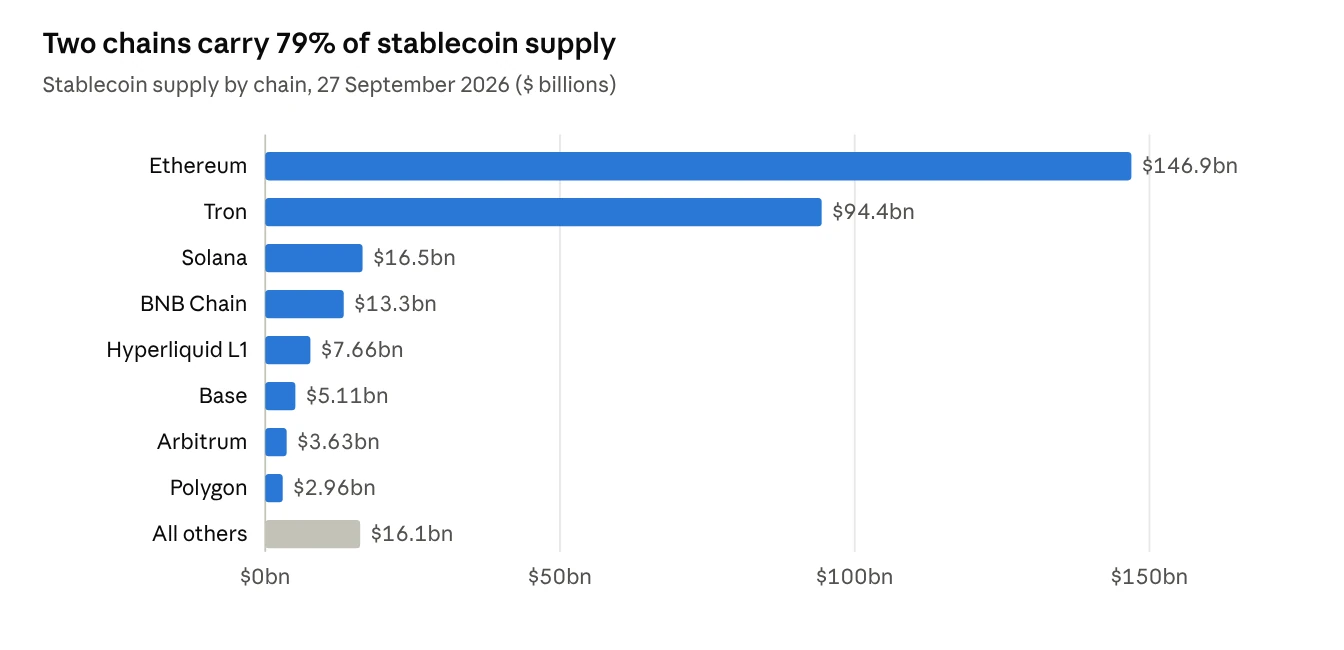
Ethereum and Tron carry about 79% of the roughly $307bn supply (DefiLlama). Tether’s USDT dominates both, making up about half of Ethereum’s stablecoins and 98% of Tron’s.
- Chains. Solana and BNB Chain follow at about 5% and 4%, and a long tail of smaller networks holds the rest (DefiLlama). A coin on one chain is not interchangeable with the same coin on another without a bridge or a conversion (BIS Annual Economic Report 2026).
- Currencies. The BIS puts the US dollar share of fiat-backed stablecoins at 99.4%, which leaves every other currency together with less than 1% (BIS Annual Economic Report 2026).
- Uses. BCG and Allium estimate that of more than $62tn in gross stablecoin transfers in 2025, about $4.2tn reflected real economic activity, and $350bn to $550bn was payments for goods and services, growing about 60% a year (BCG, January 2026). The rest was trading, collateral movements and routing between wallets and venues.
The firms that settle these flows fall into seven groups. Their netting potential, our assessment below, depends on whether their obligations run in both directions.
| Participant | What they settle | Direction of flow | Netting potential |
|---|---|---|---|
| OTC desks and market makers | Trades with clients and venues across chains | Two-way | High |
| Exchanges and liquidity venues | Settlement with desks, deposits and withdrawals | Two-way | High |
| Payment companies and corridor liquidity providers | Conversions and payouts across corridors | Two-way in aggregate | Medium to high |
| Remittance firms | Inbound transfers and local payouts | Mostly one-way, offset by business payments | Medium |
| Stablecoin issuers and ramps | Mint, redeem and conversion flows | Two-way | Medium |
| Tokenised asset platforms | Subscriptions, redemptions and secondary trades | Two-way across distributors | Medium |
| Agent commerce hubs | Payments for API calls and services | One-way per agent, two-way per hub | Grows with hubs |
Netting value follows reciprocity. The more participants owe each other in both directions, the less money has to move.
The problem: how stablecoin markets settle today
Stablecoins now form a pool of about $307bn of on-chain dollars (DefiLlama), yet most of it settles much as FX did before CLS: gross, one transfer at a time, and prefunded. The BIS estimates 2025 stablecoin transaction volume at $28tn, with payments to third parties under 1% of that value; most of the rest is trading and funds moving between wallets and venues (BIS Annual Economic Report 2026). That movement is exactly the flow that clearing exists to shrink.
Five frictions follow from settling this way:
- Gross movement. Every obligation moves in full, including flows that would cancel against obligations running the other way.
- Prefunding. Balances sit in advance at each venue and on each chain. The BIS identifies reducing prefunding as one of the main gains programmable settlement can deliver (BIS Annual Economic Report 2026).
- Fragmentation. A stablecoin on one chain is not equivalent to the same coin on another, and the BIS notes the absence of an agreed clearing and settlement system across ledgers. Bridges that connect them add operational risk (BIS Annual Economic Report 2026).
- Settlement risk without a remedy. Where FX trades could not use payment-versus-payment settlement in 2025, 57% of counterparties lacked access, 36% of currency pairs were ineligible, and same-day trades fell outside cut-offs (BIS Quarterly Review, June 2026).
- Access thresholds. CLS settles directly for over 75 settlement members, with 38,000 other firms reaching it through them (CLS). CME requires at least $50m of capital to clear any OTC product (CME).
The firms most exposed are the ones in between: OTC desks, payment companies, remittance firms, local stablecoin issuers and tokenised asset platforms. They are too small or too specialised for clearing houses, yet large enough to lose real money to gross settlement.
The economics of gross settlement
Gross settlement carries four costs that grow with activity, and netting reduces all four.
- Settlement tolls. Gas, conversion spreads and bridging fees, paid on every dollar that moves. Gross settlement moves all of gross flow; netting moves only the share that does not offset.
- Prefunding carry. Balances parked at venues and on chains, multiplied by the cost of funds. The balance grows with the number of venues and the days of flow a firm keeps in place.
- Counterparty exposure. Whoever delivers first carries the other side until it pays. The cost scales with the size of the exposure and how long it lasts.
- Operations. Reconciliation, failed transfers and rebalancing across chains are paid per transfer, so they scale with the number of transfers.
Covered netting adds one cost of its own: cover, the net debit multiplied by the cost of funds for the length of a run.
The netting ratio drives most of the saving. For a firm settling $100m a day at a settlement toll of 3 bps:
| Netting ratio | Money moved per day | Annual settlement tolls | Value settled per $1 moved |
|---|---|---|---|
| 0% (gross) | $100m | $10.95m | 1.0 |
| 40% | $60m | $6.57m | 1.7 |
| 55% | $45m | $4.93m | 2.2 |
| 70% | $30m | $3.29m | 3.3 |
| 90% | $10m | $1.10m | 10.0 |
| 96% (CLS level) | $4m | $0.44m | 25.0 |
The last column is the liquidity multiplier. CHIPS reported 26 dollars settled per dollar of funding in 2025 (The Clearing House), which shows what a dense network reaches.
Putting the lines together for the same firm, with one day of flow prefunded, a 4% cost of funds and a one-hour run:
| Cost line | Gross, prefunded | Covered netting at 55% |
|---|---|---|
| Settlement tolls at 3 bps | $10.95m | $4.93m |
| Prefunding carry, one day at 4% | $4.00m | None |
| Cover carry, one-hour run at 4% | None | $0.08m |
| Total, before fees and exposure charges | $14.95m | $5.00m |
Two points follow. The saving of about $10m a year, before fees, has to cover whatever a clearing arrangement charges, so fees should be judged against it. And cover costs little because it is held for a run rather than a day; the relevant comparison is the margin a CCP holds for the life of each position.
The options
Firms settling stablecoin obligations can choose from six broad models. Each trades settlement risk, liquidity and access differently, and none wins on every measure.
| Model | Settlement risk | Liquidity needed | Losses after a default | Access | Best suited to |
|---|---|---|---|---|---|
| Gross DvP, trade by trade | None on the settled legs | Full gross value | Stay with each pair | Open to anyone on the rails | Occasional trades between few parties |
| Bilateral netting | Reduced, not removed | Net per counterparty pair | Stay with each pair | A legal agreement per pair | A handful of large counterparties |
| Deferred net settlement | Present until settlement | Net, paid later | Unwinds or loss-sharing rules | System members | High-volume, low-value payments |
| Central counterparty | Guaranteed by the CCP | Margin, plus net settlement | Mutualised through a default fund | Capital thresholds, or a clearing broker | Standardised, long-dated exposures |
| PvP system on the CLS model | None for members in eligible currencies | Net pay-ins on a fixed daily schedule | Largely avoided; loss-sharing in extreme cases | Settlement members, mostly large banks | Bank FX in eligible currencies |
| Covered multilateral netting | None at execution; bilateral before each run | Net, and only for the run | Stay with each pair | Any member that can cover its net | Short-dated obligations across venues and chains |
How each model works
Gross delivery-versus-payment. Each trade settles on its own, and both legs move together or not at all. That removes settlement risk on the settled legs. The price is liquidity, because the full gross value must be in place for every trade, plus a toll on every transfer.
Bilateral netting. Two counterparties offset their trades into one payment per asset, as 1990s FX netting services did. It cut settlement flows by about half (BIS, December 2002), but each pair needs its own legal agreement, and the benefit shrinks as counterparties multiply.
Deferred net settlement. Obligations accumulate through a cycle and settle as net positions at its end. It saves liquidity, but participants carry each other’s credit risk until settlement, and a failure forces unwinds or loss-sharing. In 1974 the Herstatt disruption spread through New York’s net settlement system for exactly this reason (BIS, December 2002).
Central counterparty. The CCP becomes buyer to every seller and seller to every buyer, and guarantees performance (LCH Group Annual Report 2024). Initial margin, variation margin and a default fund sized to the two largest member defaults pay for the guarantee, and members can be called for more. Access takes capital or a clearing broker.
Payment-versus-payment on the CLS model. Both currencies of a trade settle at the same moment on the system’s books. Members fund only their net positions, on a fixed schedule, and a positive balance rule keeps each member covered (BIS, December 2002). There is no guarantee: a failed pay-in leaves some trades unsettled rather than passing a loss to others. Membership is limited to large institutions, in eligible currencies, within set hours.
Covered multilateral netting. It applies the CLS approach to obligations on stablecoin rails. Obligations net across venues, chains and assets, each net debit is covered before a run commits, any member that can cover its net may join, and runs operate around the clock. The next section sets out its elements.
Each model earns its place somewhere. A CCP remains the right tool where exposures run for months and a guarantee is worth its cost. Gross DvP is the simplest choice for occasional trades.
The gap is short-dated obligations among many firms trading in both directions. That is where covered multilateral netting combines the netting of a clearing house with the open access of on-chain settlement.
The solution: covered multilateral netting
Covered multilateral netting keeps the part of clearing that creates value, netting, and removes the need for a guarantee. It rests on ten elements, and every clearing run follows the same sequence.
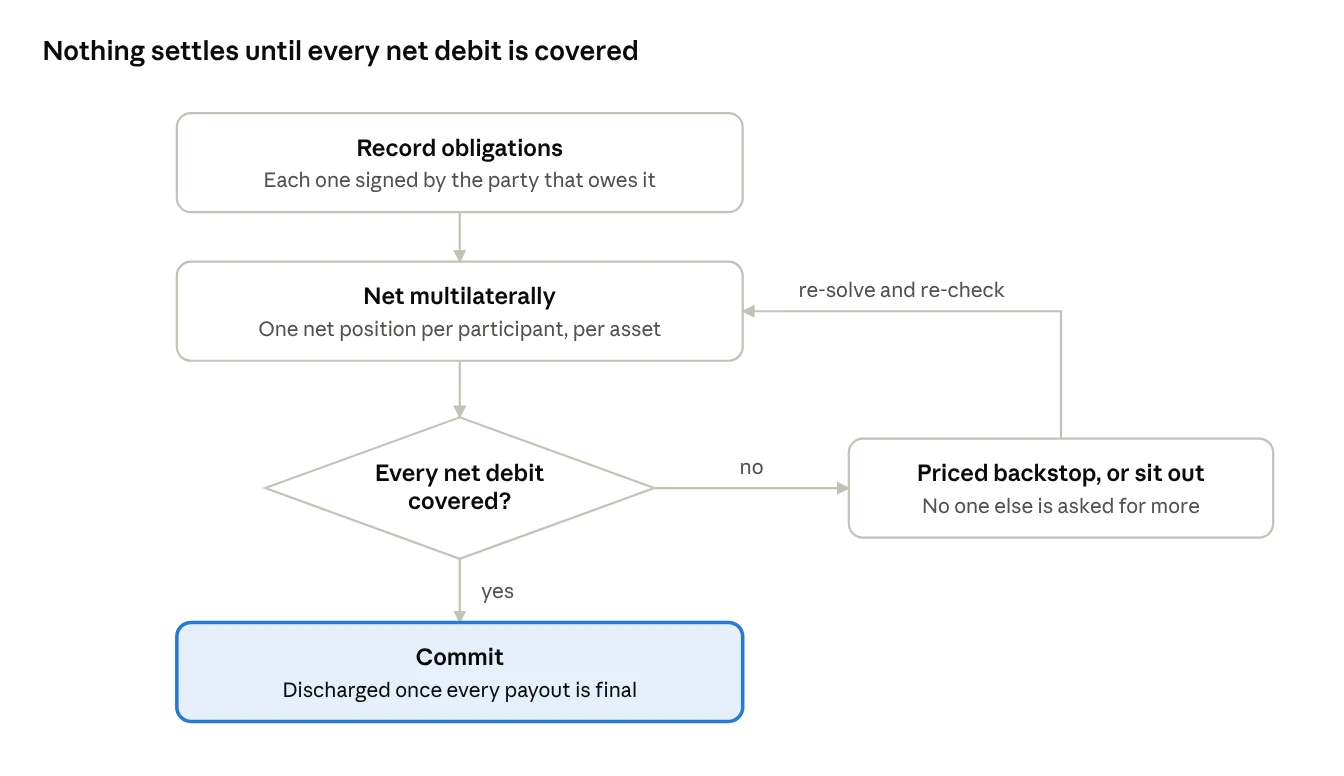
Obligations are recorded and netted, and the run commits only once every net debit is covered. A shortfall goes to a priced backstop, or the participant sits out while the run re-solves.
1. Obligations as the unit of clearing
Each obligation is recorded once and signed by the party that owes it. It carries its own compliance status and the authority behind it, such as which principal an agent acts for. Because the obligation clears rather than the account, firms that never joined a common clearing house can net against each other.
2. Netting across venues, assets and chains
Obligations from different venues and chains net in the same run, leaving each participant one net position per asset. Where a participant’s positions sit in different assets or on different chains, liquidity providers can close the gap through conversion at a quoted price.
3. Cover before commit
A run commits only when every net debit is funded. Cover equals the net, never the gross, and it is held only for the run. CLS applies the same principle through a positive balance rule and a pay-in schedule (BIS, December 2002), and Project Agorá settles atomically only after the required balances are reserved and locked (BIS Annual Economic Report 2026).
4. Discharge only on final settlement
Matched obligations are discharged only when every payout in the run is irreversibly final on its chain. Legs confirm at different times across chains, so until the last one is final, every obligation in the run stays open. A leg that stalls leaves creditors with their original claims, never with a discharged debt and no payment, and a failure never leaves a creditor facing a party it did not contract with.
5. Shortfalls without mutualisation
If a participant cannot cover, a priced liquidity backstop can fund the gap at that participant’s cost. Otherwise the participant sits the run out, and the run re-solves within the cover others have already posted. No one is asked for more, and there is no default fund. CLS handles a failed pay-in in a similar way: some transactions stay unsettled and pay-ins are recalculated (BIS, December 2002).
6. Verification and privacy
Each participant can check its net position against the obligations it signed before a run commits. Positions stay private to their owners, and no participant sees another’s book. The confidentiality section below sets out who else sees what.
7. Legal basis
A rulebook gives set-off its legal effect only when a run completes, not before. In this paper, set-off means that discharge of matched obligations. Depending on the jurisdiction, a rulebook may achieve it through payment via a settlement agent rather than legal set-off, because insolvency set-off generally requires mutual debts between two parties. Participants should expect the operator to show how discharge and cover hold up if a member becomes insolvent, in each jurisdiction where members operate.
8. Run cadence and deadlines
Runs follow a schedule set by the rulebook: frequent enough to keep exposures short, and spaced enough for offsetting obligations to build up. Participants choose, per obligation, how soon it must settle, from within hours to a T+1 or T+2 basis.
Longer deadlines let more offsets accumulate and raise the netting ratio. Shorter ones cut the time an obligation remains a bilateral promise. An obligation not settled by its deadline leaves the network and settles gross, as it would have without netting.
9. Liquidity and conversion
Netting leaves each participant a residual per asset and per chain. When a participant is short one stablecoin on one chain and long another elsewhere, liquidity providers can quote a conversion that closes the gap inside the run. Shared liquidity pools can also fund timing gaps and cover shortfalls at a published price. Liquidity is always priced and voluntary, and it never stands behind an uncovered position.
10. Compliance by design
Every participant is identified and verified before it can submit an obligation, and each obligation is screened before it enters a run. The BIS argues that platforms embedding anti-money-laundering pre-screening, sanctions screening and auditable data trails in the transaction flow could uphold financial integrity at scale (BIS Annual Economic Report 2026). An obligation that fails screening never nets, so one participant’s compliance failure does not contaminate anyone else’s position.
Worked example: one clearing run
Four firms enter a run with six obligations between them, all in the same stablecoin on the same chain.
| Payer | Payee | Amount |
|---|---|---|
| Firm A | Firm B | $30m |
| Firm A | Firm D | $15m |
| Firm B | Firm C | $25m |
| Firm B | Firm D | $15m |
| Firm C | Firm A | $10m |
| Firm D | Firm B | $5m |
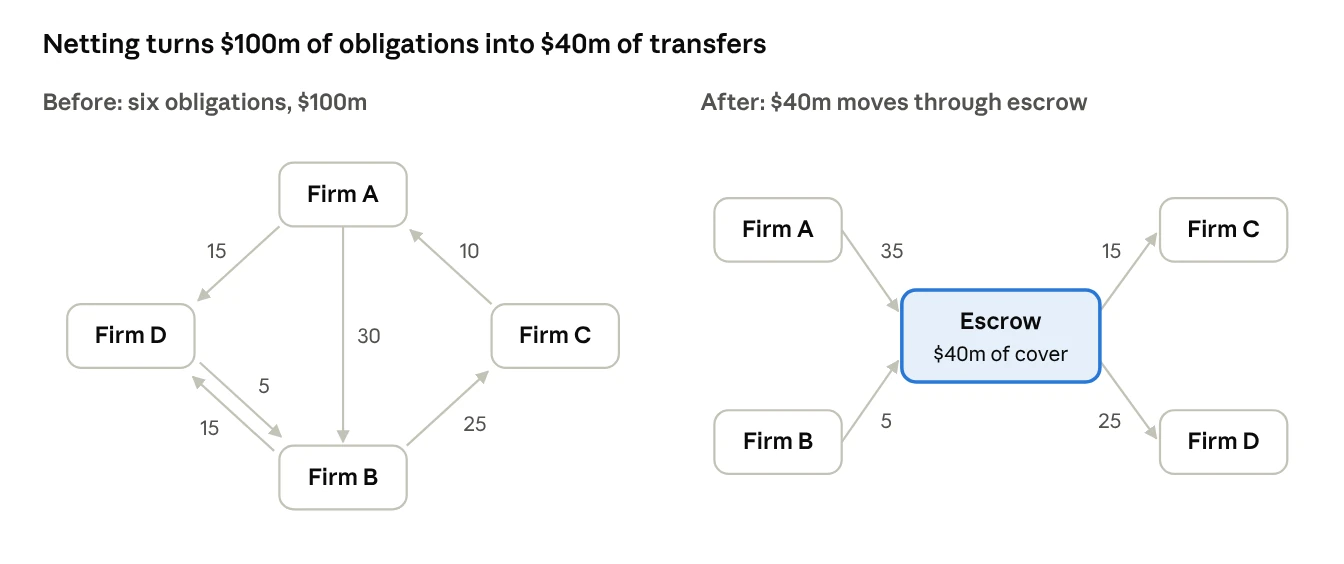
Netting reduces each firm to one position, and only net payers post cover:
| Firm | Owes | Is owed | Net position | Cover posted |
|---|---|---|---|---|
| Firm A | $45m | $10m | Pays $35m | $35m |
| Firm B | $40m | $35m | Pays $5m | $5m |
| Firm C | $10m | $25m | Receives $15m | None |
| Firm D | $5m | $30m | Receives $25m | None |
| Total | $100m | $100m | $40m moves | $40m |
- Record. The paying firm signs each obligation, and it is screened before it enters the run.
- Net. Each firm’s obligations sum to one net position, and $100m of obligations reduce to $40m of net debits.
- Cover. Firms A and B place $35m and $5m in escrow. Firms C and D post nothing, because they only receive.
- Commit. With every net debit in escrow, escrow pays Firm C $15m and Firm D $25m. Once both payouts are final, the six obligations are discharged.
The $100m of obligations settles with $40m moving: a netting ratio of 60% and a liquidity multiplier of 2.5. Settled gross, the same obligations would have needed $100m of funding. Firm B clears $75m of payments in and out with a single $5m transfer.
If a firm fails to cover. Suppose Firm B never posts its $5m. The run re-solves without B, within the cover already posted. Without B’s payments, Firm C would owe Firm A a net $10m but has posted no cover, so that obligation waits as well. The run settles what is fully funded: Firm A pays Firm D $15m from its escrow, and the other $20m of A’s cover is released. The remaining obligations carry to the next run or settle gross by their deadlines. No firm is asked for more, and nothing settles uncovered.
Across assets and chains, the same arithmetic runs per asset and per chain. Where a firm is short one asset and long another, a liquidity provider can quote the conversion inside the run.
Confidentiality: who sees what
Netting needs a view of every participant’s obligations, and that view is what trading firms guard most closely. Covered netting keeps it inside a trusted execution environment, so the operator can run the network without being able to read it.
How the netting engine stays private
A trusted execution environment (TEE) is an isolated area of a processor that runs code the machine’s owner cannot inspect or alter. In the design described here, it protects a run in four steps:
- Attest. Before any participant sends data, the enclave proves which code it is running through remote attestation, a measurement signed by the processor.
- Encrypt. Participants encrypt their obligations to a key held only inside the enclave. The operator relays and stores data it cannot read.
- Screen and net. Compliance screening and netting both run inside the enclave, so obligations, counterparties and gross flows never appear outside it.
- Release. The enclave releases only what settlement needs: each participant’s own result, encrypted to that participant, and the cover and payout instructions for escrow.
| Party | What it sees | What it cannot see | What protects the boundary |
|---|---|---|---|
| Your direct counterparties | The obligations between you, and whether they settled | Your other counterparties, net position or cover | Each obligation is visible only to its two parties |
| Other participants | Their own obligations and results | Anything about your obligations, position or cover | Results are encrypted to each participant |
| Liquidity providers | The conversion or funding they are asked to quote: asset, amount and timing | Who you trade with, or why you are short | Requests carry no counterparty detail |
| The operator | Encrypted submissions, attestation reports, and each firm’s cover and payout | Obligations, counterparties and gross flows | The enclave, remote attestation and encryption to enclave keys |
| The public | Cover and residual transfers on public chains | The obligations behind them, or gross flows | Netting shrinks and aggregates what reaches the chain |
Netting is itself a privacy tool. Gross settlement puts every trade on-chain as its own transfer, so anyone can map a firm’s flows. A run puts one net transfer per firm, asset and chain on-chain at a scheduled time, which blends many counterparties and trades into a single amount.
Integrity does not rest on the enclave. The design requires that a compromised enclave could leak data but never make a participant pay more than it agreed: each participant checks its own net position against the obligations it signed and locks only that cover, and payouts are capped at what was locked. Zero-knowledge proofs that each run balances, without revealing any book, are in design as a further check.
The trade-off. A TEE moves trust from the operator to the chip manufacturer and to the code the enclave runs. Hardware enclaves have needed repeated security patches, and side-channel attacks remain an active research area. Remote attestation, reproducible builds, keys that change every run and prompt patching narrow that risk without removing it. Participants should ask any provider which code its enclave runs, who can change it, and how they would know.
Beyond hardware trust. Fully homomorphic encryption (FHE) computes directly on encrypted data, so no machine ever sees obligations in the clear, and it removes the reliance on chip manufacturers that a TEE carries. It is far slower, especially for the comparisons a cover check needs, and its decryption key must be split across independent parties so that no single holder can read the results. The design pairs the two: a TEE for performance, with FHE being evaluated for the netting arithmetic, where sums on encrypted positions are practical.
Lawful access. Confidentiality cannot block legal duties. Records the law requires stay available to compliance staff and to authorities through dual-controlled, logged access, so the enclave never stands in the way of suspicious activity reports, travel rule data or responses to production orders.
When things go wrong
A settlement model is best judged by what happens on a bad day. The table sets out how covered netting handles nine failure scenarios, and who bears the cost of each.
| Scenario | What happens | Who bears it |
|---|---|---|
| A participant cannot fund its net debit | A priced backstop can fund it; otherwise the participant sits the run out and the run re-solves within the cover others have posted | The participant pays the backstop, or its counterparties wait for a later run |
| A participant becomes insolvent before a run | It is excluded before execution, so none of its obligations is discharged; counterparties keep their bilateral claims | Its direct counterparties, as with bilateral settlement |
| A participant becomes insolvent just after a run | The run has settled, but in some jurisdictions, including England, a run completed after an undetected winding-up petition can still be challenged | Depends on the rulebook and local insolvency law; statutory designation removes the risk where it is available |
| A settlement stablecoin loses its peg mid-run | The rulebook decides whether the run halts, reprices or carves out the asset | Holders of that coin carry the issuer risk |
| An issuer freezes an address holding cover | Cover at that address cannot move until the freeze lifts, and the run re-solves without it | Participants whose cover sits there; segregating cover per participant confines a freeze to its target |
| A chain halts or a cross-chain message stalls | Funded legs wait, nothing unfunded executes, and obligations stay open until every payout is final | Everyone involved bears delay, not loss |
| A participant fails a sanctions check mid-cycle | Its obligations are excluded before execution, and the run re-solves | That participant |
| A liquidity provider fails to deliver a conversion | The affected position is re-solved or funded through the backstop | The liquidity provider, under its own terms |
| The operator itself fails | Outcomes depend on who controls cover while a run completes | Participants, unless cover sits outside the operator’s control |
The pattern matters more than any single row. In deferred net settlement, several of these events force an unwind that changes other participants’ positions. In a CCP, they fall on the default fund. In covered netting, each lands on the participant that caused it, or on a liquidity provider that chose to take it for a price.
Two rows still depend on documents rather than design: insolvency just after a run, and operator failure. Both belong in any legal review.
Evidence and case studies
Nine cases answer the questions readers ask most often. Cases 1 to 3, 6 and 7 are historical and sourced; cases 4, 5, 8 and 9 are illustrative scenarios with their assumptions stated.
Case 1: CHIPS moves from deferred to covered settlement
Question: does netting still work when every payment must be funded first? In 2001, CHIPS launched a payment-matching algorithm that clears and settles payments in real time using minimal liquidity (The Clearing House, 2020). In 2025 it settled an average of $2.014tn a day with about $96bn of funding, against an estimated $442bn under gross settlement (The Clearing House, 2026). Funding under 5% of value shows covered netting working at scale.
Case 2: CLS and the limits of access
Question: does removing principal risk require a guarantee? CLS removes principal risk for its members without becoming their counterparty. If a member fails to pay in, some transactions stay unsettled and other members’ pay-ins are recalculated; loss-sharing applies only in extreme cases (BIS, December 2002). Its netting cuts funding needs by over 96% on average (CLS). Yet $1.4tn a day still settled fully exposed in 2025, mostly because counterparties lacked access or currencies were ineligible (BIS, June 2026). The model works; access is the constraint.
Case 3: what a guarantee costs
Question: what do members pay for mutualised protection? At end-2024, LCH members had contributed €17.3bn to default funds and committed about twice that again if needed. LCH also earned €313.4m of net treasury income on cash held for margin and default funds (LCH Group Annual Report 2024). CME requires $50m of capital to clear OTC products, and at least $15m of guaranty deposit for interest rate swaps (CME). That protection is worth its cost for long-dated exposures, and far less so for obligations that settle within hours.
Case 4, illustrative: a desk trading across venues
Question: what would covered netting release for one firm? Assume a desk settles $100m a day across several venues and chains, keeps one day of flow prefunded, pays 3 bps to move each dollar, funds itself at 4% and nets 55% of its gross flow. These are assumptions, not client data.
- Settlement tolls. Only $45m of each $100m moves, saving about $6.0m a year before any clearing fee.
- Prefunded balances. The $100m buffer is no longer needed, which is worth about $4m a year at a 4% cost of funds.
- Cover. Locking the $45m net debit for a one-hour run costs about $205 per run, or roughly $75,000 a year.
Case 5, illustrative: an emerging-market corridor
Question: does it help where payment-versus-payment settlement does not reach? Assume a corridor carries $5m a day of inbound remittances and $3m a day of outbound business payments, converted between a USD stablecoin and a local-currency stablecoin at a 30 bps spread.
- Conversion. The flows offset, so only the $2m imbalance needs converting. Conversion volume falls by 75%, saving about $6.6m a year.
- Settlement risk. Both stablecoin legs of every conversion settle together or not at all.
- Local balances. Two days of balances at each end would tie up $20m; cover is needed only for each run’s net position.
Case 6: netting before payment-versus-payment
Question: is netting enough on its own? In the 1990s, a multilateral FX netting service cut the settlement flows it handled by about 70%, against 50% for bilateral netting. Neither achieved simultaneous finality of both legs, so settlement risk remained (BIS, December 2002). Netting shrinks what moves; only covered, simultaneous settlement removes the risk in what is left.
Case 7: Project Agorá
Question: is the public sector converging on the same sequence? Project Agorá brings together eight central banks and over 40 regulated institutions to test a shared platform for tokenised deposits, with separate ledgers for each jurisdiction’s tokenised reserves. Once validation is complete and the required balances are reserved and locked, payments settle atomically across currencies. Legal analysis for the project indicates that settlement finality can be aligned with national frameworks through clear rules (BIS Annual Economic Report 2026).
Agorá is a prototype, and the BIS notes that production would need further work on resilience and governance. Its design still points one way: lock the funds first, then settle everything at once. Covered netting applies that sequence to netted residuals.
Case 8, illustrative: a tokenised money market fund
Question: what changes for a platform whose redemptions settle on T+1? Assume a $200m tokenised fund holds a 5% cash buffer, and distributors subscribe $4m and redeem $3m on an average day, all against stablecoins.
- Principal risk. Each subscription and redemption settles delivery-versus-payment, so neither side delivers first.
- Primary flow. The $3m of redemptions offsets against subscriptions, and only the $1m net reaches the fund’s primary cycle.
- Buffer. If a liquidity provider buys redemptions for same-day cash at a published discount, the fund needs less cash on hand. Each percentage point of buffer released puts $2m to work in the strategy.
Settling tokenised securities brings securities settlement rules into scope, such as clearing agency registration in the US and CSDR or the DLT Pilot Regime in the EU. This case assumes the platform and its fund already operate within those rules.
Case 9, illustrative: an agent commerce hub
Question: does netting matter for very small payments? Assume a hub handles 100,000 paid requests a day at an average of $0.05, or $5,000 a day, and on-chain transfers cost $0.005 each.
- Per-request settlement. 100,000 transfers cost $500 a day, or 10% of the value moved.
- Covered netting with hourly runs. Obligations net to one residual per asset per run: 24 transfers a day, costing about $0.12.
- Where netting lives. A single agent mostly pays one way. Hubs that both buy and sell services carry two-way flow, and that flow is what nets.
Simulation: what drives the netting ratio
This paper’s illustrations assume a netting ratio of 55%. To test what produces a ratio like that, we built a simple synthetic model of a netting network and ran it 2,000 times for each setting. The results come from the model, not from client data.
- Members. Each network has between 5 and 100 member firms. Activity varies widely between them, with a few large firms and many small ones.
- Two-way share. Each firm leans towards paying or receiving. The two-way share is the part of each firm’s flow that runs in both directions: 25%, 50%, 60% or 75%.
- Density. In the base case, each pair of members generates one obligation per run on average, so a 25-member run holds 300 obligations.
- Obligations. Payers and payees are drawn in proportion to each firm’s activity and lean, and obligation sizes vary widely.
- Result. Netting ratio = 1 − net debits ÷ gross obligations, as in the appendix.
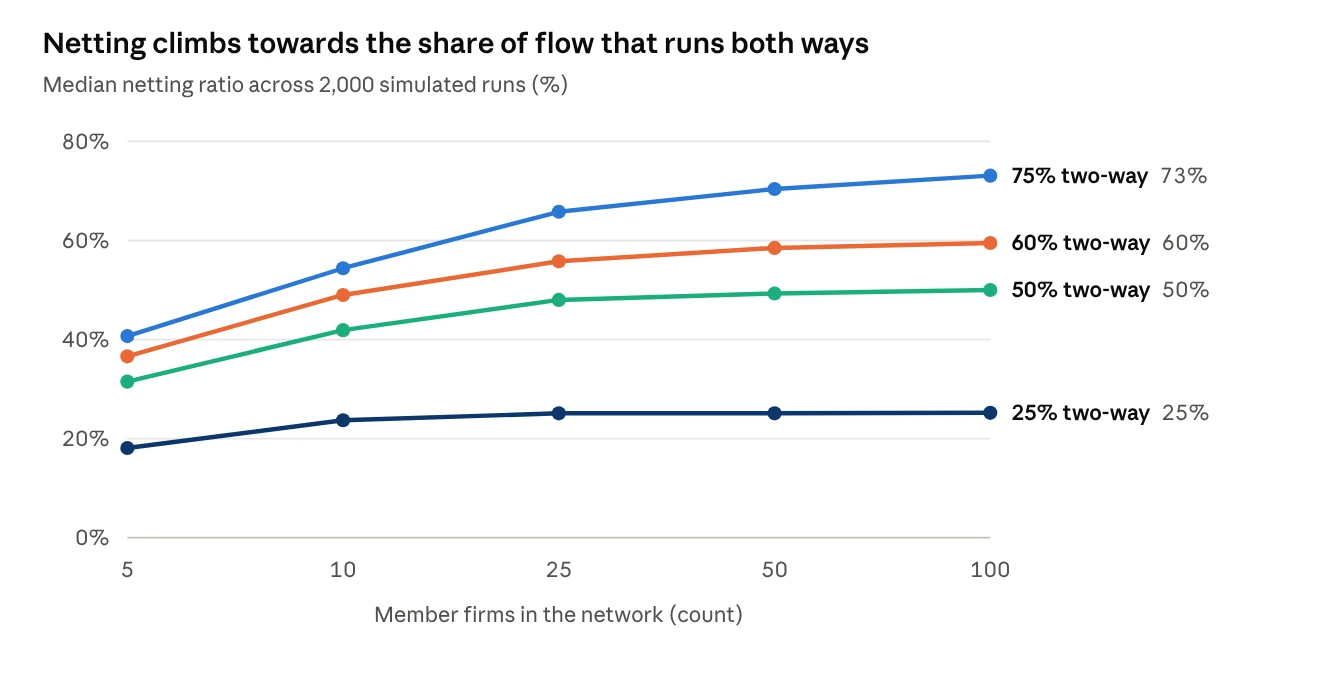
Three findings follow.
Reciprocity sets the ceiling
The netting ratio climbs towards the two-way share of members’ flow and does not pass it. A 25-member network whose flow is 60% two-way nets about 56%, close to this paper’s illustrative 55%.
Density decides how close a network gets, and how steady it is
Small networks sit well below the ceiling and swing widely from run to run. At 50% two-way flow, the middle 80% of five-member runs netted anywhere from 6% to 63%; at 100 members, that range narrowed to 47% to 53%. Longer runs raise density the same way until the ceiling is reached, shown here for 25 members at 50% two-way flow:
| Obligations per pair of members per run | Obligations per run | Median netting ratio | Middle 80% of runs |
|---|---|---|---|
| 0.2 | 60 | 36% | 24% to 50% |
| 1 | 300 | 48% | 39% to 57% |
| 5 | 1,500 | 51% | 45% to 59% |
| 25 | 7,500 | 51% | 47% to 58% |
Fragmentation costs a fifth to a quarter of the saving
In this test, each obligation lands on one of five chains in proportion to current stablecoin supply (DefiLlama), with 25 members. Netting each chain separately loses part of the benefit, and conversion inside the run recovers it:
| Two-way share | Netted across chains, with conversion | Netted per chain | Conversion needed (share of gross) |
|---|---|---|---|
| 50% | 48% | 39% | 9% |
| 75% | 66% | 51% | 15% |
Limits. The model treats obligations as independent, fixes each firm’s lean, and ignores timing within a run, strategic behaviour, credit limits and firms’ own chain preferences, any of which could raise or lower the ratios. It shows how the netting ratio responds to membership, reciprocity, density and fragmentation. It does not predict any firm’s ratio; a simulation on a firm’s own records does that.
Regulatory and legal landscape
Covered netting sits where three bodies of rules meet: stablecoin regulation, standards for settlement systems, and insolvency law. None was written with it in mind, and each shapes how it must be designed and used.
Stablecoin regulation
The US GENIUS Act, signed in July 2025, created the first federal regime for stablecoins. It requires 100% reserve backing with liquid assets such as dollars or short-term Treasuries, monthly public disclosure of reserves, priority for holders if an issuer becomes insolvent, and anti-money-laundering and sanctions programmes at every issuer (White House, July 2025). In the EU, MiCA has required issuers of e-money and asset-referenced tokens to be authorised since 30 June 2024 (Central Bank of Ireland). Hong Kong granted its first licences under its Stablecoins Ordinance on 10 April 2026 (HKMA, April 2026).
For clearing, regulation decides which coins regulated firms can hold and settle in. Issuer quality then sets the risk in the settlement asset.
Standards for settlement systems
In 2022, the CPMI and IOSCO confirmed that the Principles for Financial Market Infrastructures apply to systemically important stablecoin arrangements that transfer stablecoins, under the heading “same risk, same regulation”. Their guidance singles out governance, risk management, settlement finality and money settlements (BIS, July 2022).
A netting network that grows to systemic scale should expect the same test. The principles translate into direct design questions:
| Principle area | Core question | How covered netting responds |
|---|---|---|
| Legal basis | Are the rules enforceable in every relevant jurisdiction? | A rulebook that discharges obligations only when a run completes, reviewed where members are based |
| Credit risk | Who is exposed to whom, and for how long? | No credit at execution; bilateral exposure only before each run |
| Liquidity risk | Can the system settle if a participant fails to pay? | Cover before commit, a priced backstop, and re-solving without the failed participant |
| Settlement finality | When does settlement become irrevocable? | When every payout in the run is irreversibly final on its chain; until then, obligations stay open |
| Money settlements | What asset settles, and what risk does it carry? | Regulated stablecoins, with issuer risk disclosed and diversified |
| Exchange-of-value settlement | Is each leg final only if the other is? | Delivery-versus-payment on every leg, and set-off conditional on settlement |
| Participant default | What happens when a participant fails? | Exclusion before execution, with no shared losses |
| Access | Are entry criteria fair, open and risk-based? | Any verified member that can cover its net |
Insolvency and enforceability
Systems designated under settlement finality laws receive statutory protection for their netting and finality. Most stablecoin netting arrangements rely on contract instead, and English law shows why that matters:
- Equal treatment of creditors. In British Eagle v Air France (1975), the House of Lords held that a contractual clearing arrangement could not override the rule that an insolvent company’s unsecured creditors share equally.
- Retrospective avoidance. Under section 127 of the Insolvency Act 1986, a company’s dispositions after a winding-up petition is presented are void if a winding-up order follows, unless a court validates them. A run that completes after a petition nobody has noticed can be challenged.
- Designation. Designation under the Settlement Finality Regulations removes both risks, but the regime is built around banks, investment firms and similar institutions, so a network of non-bank stablecoin firms may not qualify.
Covered netting narrows the exposure without removing it. Nothing is discharged before a run completes, a failed member is excluded rather than netted, and runs are short. Solvency warranties at each run, monitoring for petitions and prompt exclusion narrow it further.
Four questions decide how a given arrangement holds up:
- When does discharge take legal effect: at recording, at netting or when a run completes?
- Can a liquidator challenge a run that completed shortly before or after a member’s insolvency?
- Is cover held on trust, as collateral, or as the participant’s own property? As collateral, stablecoins may fall outside the financial collateral rules that protect cash and securities.
- Which law governs, and will courts where members sit recognise it?
Public projects suggest these questions have answers. Legal analysis for Project Agorá indicates that settlement finality can be aligned with national frameworks through clear rules (BIS Annual Economic Report 2026).
Financial integrity
The BIS finds that stablecoins account for a significant share of illicit on-chain activity, and argues for integrity built into the transaction flow, citing the FATF’s 2026 report on stablecoins and unhosted wallets (BIS Annual Economic Report 2026). A network that screens every obligation before it nets addresses the concern where obligations enter.
The operator’s own perimeter
Rules for issuers do not settle the position of the network that settles between firms. Before going live, an operator should map its activities against the rules in each jurisdiction where members sit:
- United Kingdom. Firms that exchange cryptoassets for others, or arrange exchanges, must register with the FCA under the Money Laundering Regulations, and the forthcoming cryptoasset regime brings dealing, arranging and safeguarding into authorisation.
- European Union. The EBA treats transfer and custody services involving e-money tokens as payment services, and crypto-asset service providers needed a payment institution licence, or a partnership with a licensed provider, by 2 March 2026 (Central Bank of Ireland).
- United States. State money transmission rules can apply to services that move stablecoins on behalf of others.
Depending on its design, an operator may need registrations of its own, or licensed partners, in each market.
Trade-offs and limits
Covered netting is a settlement model, not a guarantee. Any firm evaluating it should weigh these limits.
- Scope. It suits obligations that settle within hours or days. Exposures that run for weeks or months, or volatile assets held over time, need margin, and that is a CCP’s job.
- Exposure before the run. Until a run settles it, a cleared obligation is a signed bilateral promise. Deferred settlement carries the same counterparty exposure it does today.
- Liquidity. Cover equals the full net debit, where a CCP asks for margin covering only potential losses. Cover is held only for the run, so it costs little to carry (Case 4), but it must be ready in the right asset at the right time.
- Settlement asset. Stablecoins do not settle in central bank money. The BIS finds that their secondary prices deviate from par, that redemption frictions are common, and it cites USDC’s substantial deviation from parity in March 2023 (BIS Annual Economic Report 2026). Participants carry the issuer risk of whatever they settle in.
- Cross-chain operations. Positions on different chains meet through liquidity providers or bridges, which the BIS identifies as a source of operational risk (BIS Annual Economic Report 2026).
- Legal certainty. Most stablecoin netting arrangements rely on contract rather than statutory settlement finality. Enforceability in a member’s insolvency therefore rests on the rulebook and on local law in each member’s jurisdiction.
- Density. Netting depends on who shares the network. In 1990s FX, bilateral netting cut flows by about 50% and multilateral netting by about 70% (BIS, December 2002); CLS reaches over 96% with near-universal bank participation. A new network starts lower and improves as members join.
- Local-currency depth. The BIS puts the US dollar share of fiat-backed stablecoins at 99.4%. Corridors in other currencies depend on liquidity providers until local stablecoins deepen.
- Fiat edges. The BIS notes that on- and off-ramp costs can make a cross-border stablecoin transfer as expensive as a bank transfer or more. Netting cuts the number of conversions; it does not remove the cost of entering and leaving the rails.
Implementation roadmap
Firms can adopt covered netting in stages, and the early stages pay off before netting starts. The sequence below applies whichever provider or design a firm chooses.
- Map your flows. Pull 30 to 90 days of settlement records. Tag each obligation by counterparty, asset, chain, corridor and deadline, and measure how much runs in both directions with the same counterparties.
- Simulate netting. Run those records through a netting simulation to estimate the netting ratio, the residual per asset and chain, and the cover each run would need. Ask any provider to do this on your own data.
- Review the legal documents. Have counsel check when set-off takes effect, how cover is held, what happens in a member’s insolvency, and which law governs.
- Prepare treasury. Decide where cover comes from, such as wallet balances, yield-bearing positions redeemed before a run, or exchange balances. Set internal limits for exposure to each counterparty before a run.
- Onboard compliance. Complete identity verification, and connect screening so obligations are checked before they enter a run.
- Start with delivery-versus-payment. Move existing trades onto DvP settlement first. That removes principal risk and venue prefunding before any netting begins.
- Opt deferred flows into runs. Move obligations that can wait hours or a day into clearing runs, starting with counterparties who trade in both directions.
- Measure and expand. Track the metrics in the next section and bring more counterparties onto the network. Each one raises the netting ratio for every member.
Measuring results
Nine metrics show whether a clearing arrangement is delivering. Existing systems provide benchmarks for the first three.
| Metric | Definition | Benchmark or direction |
|---|---|---|
| Netting ratio | Share of gross obligations extinguished by set-off | About 70% for 1990s multilateral FX netting (BIS, December 2002); over 96% funding reduction at CLS (CLS) |
| Liquidity multiplier | Value settled per dollar of funding | 26 at CHIPS in 2025 (The Clearing House) |
| Funding requirement | Cover needed per run, as a share of gross | About 5% at CHIPS in 2025 ($96bn against $2.014tn a day) |
| Settlement cost per $1m | Tolls, fees and carry, divided by gross settled | Falls as the netting ratio rises |
| Prefunding released | Venue and chain balances no longer needed | Up to the full buffer held today |
| First-run completion | Share of obligations settled in their first eligible run | Higher is better; carve-outs should be rare |
| Time to finality | Time from recording an obligation to its commit | Set by the deadline tier a participant chooses |
| Exposure before runs | Value of obligations awaiting a run, multiplied by hours waiting | Shrinks as runs become more frequent |
| Backstop use | Share of runs drawing on the backstop, and its cost | Low, and always priced |
Report each metric per asset, chain and counterparty group. An aggregate figure hides where netting works and where it does not.
Questions to ask of any clearing arrangement
These questions apply to any provider or design, including an in-house one. The answers separate netting that removes risk from netting that only moves it.
| Question | Why it matters |
|---|---|
| Is every net debit funded before settlement commits? | If not, participants extend credit to each other until settlement |
| Does set-off take effect only when the residuals settle? | Early set-off can leave a creditor exposed to a party it never faced |
| What happens when a participant cannot fund? | Look for a priced backstop and a re-solve that asks no one else for more |
| Are losses ever shared among members? | Mutualisation turns other members’ defaults into your cost |
| Can you verify your own net position before it settles? | Checking the result should not depend on trusting the operator |
| What is the legal basis for set-off in each member’s insolvency? | Contractual netting must hold up where members are based |
| Which assets, chains and currencies does it settle? | Netting only helps where your flows actually run |
| What are the operating hours and cut-offs? | Stablecoin flows run around the clock |
| How are counterparties screened? | Compliance failures travel with the obligations you net against |
| Who holds cover while a run completes, and who controls it? | Custody arrangements decide what happens if the operator fails |
| What netting ratio should you expect, and on what evidence? | Ask for a simulation on your own flows, not a headline figure |
Frequently asked questions
Is covered netting a central counterparty? No. A CCP becomes the counterparty to both sides through novation and guarantees performance. Covered netting leaves the original counterparties in place and guarantees nothing, because every net debit is funded before settlement.
Does an operator need a licence? That depends on the jurisdiction and the design. Operators should expect scrutiny under payment, settlement and cryptoasset rules, and a network that becomes systemically important should expect the PFMI to apply (BIS, July 2022).
What happens if a stablecoin loses its peg during a run? The rulebook should say in advance whether the run halts, reprices or carves out the affected asset. Participants carry the issuer risk of the coins they settle in, so issuer choice and concentration limits matter.
How is this different from bilateral netting? Bilateral netting offsets obligations between two parties; multilateral netting offsets them across every participant at once. In 1990s FX, that difference meant flows cut by about 70% rather than 50% (BIS, December 2002). Covered netting also settles the residual against funded positions, which bilateral netting does not.
Can it handle volatile assets? It can settle a volatile asset delivered against a stablecoin, because each leg moves only against the other. It does not cover price risk while an obligation waits for a run. Exposures held for days or longer need margin, and that is a CCP’s role.
Who holds participants’ funds? That depends on the design. Cover has to sit somewhere between being posted and settling, so ask who controls it, whether the operator can move it, and what happens if the operator fails.
Does netting weaken compliance or transparency? It should not. Every obligation is identified and screened before it nets, and each participant can check its own position against the obligations it signed. The netting result is arithmetic over signed obligations.
How large must a network be before netting pays? Reciprocity matters more than size. In the simulation above, the netting ratio approaches the share of members’ flow that runs in both directions, and most of the gain arrives by 25 to 50 members. A small group of firms trading in both directions can net a large share of its flow, while a large group of one-way payers nets little. A simulation on a firm’s own records answers the question for that firm.
Conclusion
Settlement risk and trapped capital are old problems with proven answers. CLS and CHIPS show that netting combined with funded settlement removes principal risk and cuts funding needs by more than 90%, without a central counterparty.
Stablecoin markets have not yet had that answer. Most firms settle gross, prefund every venue and chain, and sit outside the systems that solved the problem for banks.
Covered multilateral netting applies the proven risk model to those firms and flows. It suits short-dated obligations among firms that trade in both directions. It does not replace a CCP for long-dated exposures, and its value grows with the density of its network. Test any arrangement against the questions above, and against your own flows.
About TetraFi
TetraFi is a London-based settlement infrastructure company for stablecoin markets. Its delivery-versus-payment settlement runs on testnet ahead of the pilot, and covered multilateral netting is in design.
To discuss the ideas in this paper, contact enquiries@tetrafi.io.
Important information
This paper is intended for professional and institutional audiences and is provided for information only. It is not directed at retail investors, or at any person in a jurisdiction where its distribution would be unlawful.
- No offer or advice. Nothing in this paper is an offer, solicitation or recommendation to buy or sell any asset or service, or investment, legal, tax or accounting advice. Readers should take their own professional advice.
- Illustrative figures. The economics tables, cases 4, 5, 8 and 9, and all other illustrative figures are hypothetical and rest on the assumptions stated in the appendix. They are not forecasts, projections or guarantees of results for any firm.
- Forward-looking statements. Statements about planned products and features, including the pilot and covered multilateral netting, are forward-looking. They depend on factors including legal review and market conditions, and may change without notice.
- Regulatory status. TetraFi operates as an unregulated technology operator. It is not authorised or regulated by the Financial Conduct Authority or any other financial regulator.
- Third-party information. Market data and descriptions of other systems come from the sources cited, as available on 27 September 2026, and have not been independently verified. Names of third-party firms and systems are used for identification only and imply no endorsement.
Appendix: methodology behind the illustrative cases
The illustrative figures use simple arithmetic, so readers can rerun them with their own numbers.
- Money moved per day = gross obligations per day × (1 − netting ratio)
- Annual settlement tolls = money moved per day × toll per dollar moved × settlement days per year
- Prefunding carry = prefunded balance × annual cost of funds
- Cover carry per run = net debit covered × annual cost of funds × run length in hours ÷ 8,760
- Liquidity multiplier = 1 ÷ (1 − netting ratio)
- Conversion saving = offsetting volume per day × conversion spread × days per year
| Case | Assumptions |
|---|---|
| Economics tables and Case 4 | $100m gross a day, 365 settlement days, a 3 bps toll, a 4% cost of funds, one day of flow prefunded, 55% netting, one-hour runs |
| Case 5 | $5m inbound and $3m outbound a day, a 30 bps conversion spread, two days of balances at each end |
| Case 8 | A $200m fund, a 5% cash buffer, $4m of subscriptions and $3m of redemptions a day |
| Case 9 | 100,000 paid requests a day at $0.05 each, $0.005 per on-chain transfer, hourly runs |
The figures exclude clearing fees, execution fees, taxes, charges for exposure before runs, and on- and off-ramp costs unless a case states otherwise. Tolls vary by chain and asset, and cost of funds varies by firm. The netting ratio is the variable that moves results most, which is why a simulation on a firm’s own records should replace these assumptions.
Sources
- Bank for International Settlements (2002). Settlement risk in foreign exchange markets and CLS Bank. BIS Quarterly Review, December 2002.
- Bank for International Settlements (2022). CPMI and IOSCO publish final guidance on stablecoin arrangements confirming application of Principles for Financial Market Infrastructures. Media release, 13 July 2022.
- Bank for International Settlements (2026). FX settlement risk, BIS Quarterly Review, June 2026.
- Bank for International Settlements (2026). Anchoring trust in money: innovation beyond stablecoins. Annual Economic Report 2026, Chapter III.
- Boston Consulting Group and Allium (2026). Stablecoin Payments: The Truth Behind the Numbers. White paper, January 2026.
- Central Bank of Ireland. Markets in Crypto-Assets Regulation (MiCAR).
- CLS Group. CLSSettlement.
- CME Group. OTC clearing membership.
- DefiLlama. Stablecoins by chain, retrieved 27 September 2026.
- Hong Kong Monetary Authority (2026). HKMA grants first stablecoin issuer licences to Anchorpoint Financial and HSBC. Press release, 10 April 2026, as re-disseminated by The Asian Banker.
- LCH Group Holdings (2025). Annual Report and Financial Statements 2024.
- The Clearing House (2020). CHIPS celebrates 50th anniversary.
- The Clearing House (2026). CHIPS delivers record value and resilience for participants in 2025.
- The White House (2025). President Trump signs GENIUS Act into law. Press release, 19 July 2025, archived by The American Presidency Project.